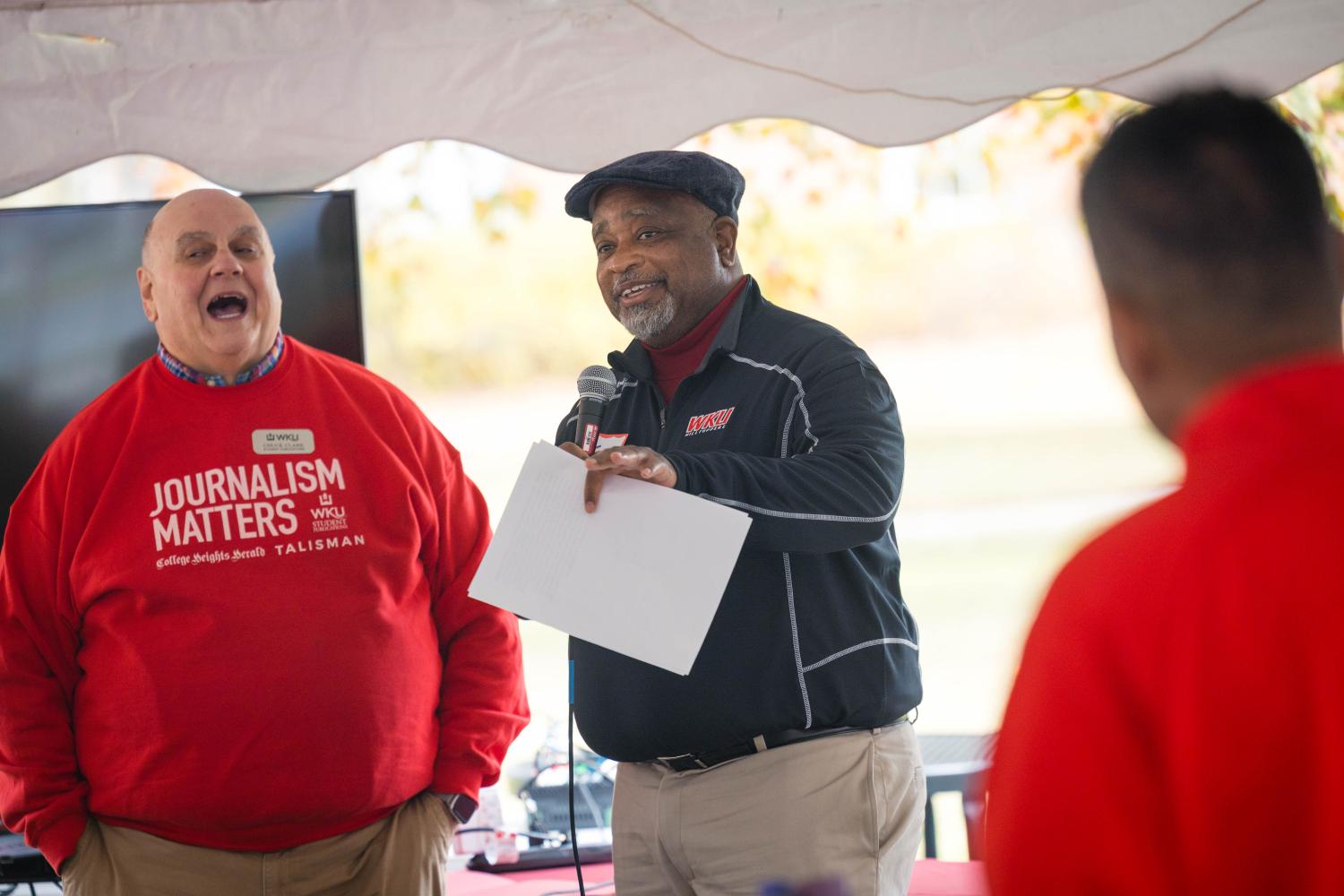

 Sam Upshaw Jr., who recently retired as a photojournalist for The Courier-Journal who shared in two Pulitzer Prizes and a former College Heights Herald staffer, was given the 2025-2026 Herald Award.

His remarks really struck us so we asked him if we could share:
This is a special place. When I first arrived on campus in 1983, I envisioned a completely different career path. I initially wanted to pursue something in the health care field, but I also had some interest in photography. I did some year book photography in high school and that experience helped me get a work study job in the media services department on Western’s campus.
However, I was fascinated by all these students running around campus with camera gear who seemed to photograph everything from a game of hacky sack to visits from famous dignitaries. I noticed there was always a common thread to their published work; passion. They weren’t just snapping pictures, they were capturing moments. I started reading the College Heights Herald and decided to submit some of my own work for publication.
The Herald’s photo editor showed some interest in one of my photographs of a Greek step show. My photo was published in the newspaper and once I saw my name in print, I was hooked. Not long after that, I changed my major to photojournalism. I was encouraged to seek out program instructor Jack Corn and we sat in his office and chatted. He remembered the photo of the step show and I can still hear his voice when he said, “that picture was kind of tilted, but we can fix that.”
Jack signed me up for his basic photography course in the Fall, but unfortunately for me, he moved on to become the director of photography at the Chicago Tribune before the class started. I missed out on Jack’s course, but I got great instruction from Mark Lyons and Mike Morse.
Dave Labelle arrived later. I remember that he introduced himself to the WKU family by sharing a slide show of one of his picture stories. It was simple. He happened to come across the unfortunate death of a dog. There was another dog there that would not leave its friend side, although it could not help. You could feel the pain and suffering experienced by the surviving dog through Dave’s photos. It was done well. That series of photos spoke to me and inspired me to want to tell similar stories.
In 1975, photojournalist Stanley Forman photographed a fire rescue scene in Boston. As a mother and her child tried to make their way down a fire escape, it collapsed and the mother fell to her death, but she broke the fall of her child who survived. Forman captured the moment as they fell and the photo ran in more than 100 newspapers across the country, predictably sparking outrage. However, that outrage led to action and federal legislation was adopted to prevent another catastrophe from defective fire escapes. Forman won the Pulitzer Prize for that photo.
I later read a book by famed photographer Gordon Parks titled “A Choice of Weapons.” In it he talks about all the injustice he witnessed in the world and how he struggled with a way to combat it. He wondered if he should respond to violence with violence or pick up his camera to highlight those injustices. He chose the latter and became one of the most accomplished photojournalist of his time; working for publications such as Life, Vogue and Ebony magazines.
This journey has taken me to assignments in at least 44 states. Not matter where I am as I meet other members or the media, I either bump into a fellow graduate or I meet people who are familiar with Western’s journalism program and its excellence.
To the students here, you will all go on to do important work. Continue to embrace the ethics that you are being taught here. That work will hold the powerful to account, inspire change and advocate for those who can’t advocate for themselves. Your work will benefit the public and even though they may be distracted, ultimately, it will benefit society as a whole. It is noble work and thank you for continuing the great tradition and legacy of this program.